Wednesday, February 23, 2022

New IBM Cybersecurity Hub To Help Asia Pacific Organizations Build Cyber Resiliency


* IBM Security Command Center in India represents significant investment in security incident response and training for organizations across APAC

* Asia was #1 most-targeted region for cyberattacks in 2021, according to IBM Security X-Force Threat Intelligence Index, released today

* New Security Operations Center (SOC) part of IBM global network for helping clients around the world respond to cyber-attacks

IBM (NYSE: IBM) today announced a multi-million dollar investment in its resources to help businesses prepare for and manage the growing threat of cyberattacks to organizations across the Asia Pacific (APAC) region. The centerpiece of this investment is the new IBM Security Command Center, the first of its kind in the region, for training cybersecurity response techniques through highly realistic, simulated cyberattack – designed to prepare everyone from C-Suite through technical staff. The investment also includes a new Security Operation Center (SOC) which is part of IBM’s vast network of existing global SOCs - providing 24X7 security response services to clients around the world.

According to new IBM global analysis released today, Asia is now the #1 most targeted region for cyberattacks – representing 26% of attacks analysed in 2021.[1] The data reveals a significant regional shift compared to the past decade of the report, where North America and Europe have historically ranked as most-targeted. This trend signals a growing need for security investments amongst Asian organizations, particularly those in financial services and manufacturing, which were the most-targeted industries in the region. The new IBM cybersecurity centers will help address the most pressing need of the hour for organizations of all types, to accelerate their security strategies and align business priorities with a security-first approach.

Located at IBM offices at Embassy Golf Links in Bengaluru, India, the new facilities represent a strategic hub for IBM cybersecurity activities in the region, which also include IBM Managed Security Services, access to IBM’s team of incident response experts, as well as IBM Consulting, IBM Research, IBM India Software Labs, and IBM Garage, a collaborative approach designed to fast-track innovation and drive meaningful, lasting transformation for clients.

The new facilities were inaugurated in presence of The new facilities were inaugurated in presence of Shri. Rajeev Chandrasekhar, Hon’ble Union Minister of State for Electronics and Information Technology and Union Minister of State for Skill Development and Entrepreneurship.

Speaking at the virtual launch, Shri. Rajeev Chandrasekhar, Hon’ble Union Minister of State for Electronics and Information Technology and Union Minister of State for Skill Development and Entrepreneurship said, "As India becomes the largest connected democracy in the world, our PM’s vision is that cyberspace will not just become a place for innovation, growth and opportunity, it will also become a place where the future standards and future technologies for securing the cyberspace evolve, mature and proliferate. I believe the Cybersecurity Hub launched by IBM today will go a long way in creating an ecosystem of not just awareness but also capabilities and talent in creating a safe cyberspace. I congratulate team IBM and look forward to a stronger partnership between the Government of India, our agencies, and IBM going forward with a common objective of realizing the Digital India mission and making sure that the Indian cyberspace becomes and remains safe and trusted."

Commenting on the launch, Sandip Patel, Managing Director, IBM India said, "One of the biggest challenges impacting the success of the exponentially growing digital economy and that of countries across the world is cybersecurity. Cybersecurity is a global challenge threatening enterprises more vigorously than ever before. We have an opportunity to respond and act now. We need cutting-edge technology and coming together of the entire ecosystem to address this threat and the launch of the IBM Cybersecurity Hub is, in fact, a response to this challenge. It will empower clients to respond to incidents with greater speed, effectiveness, and transparency."

"Preparing for a cyberattack is like fire-drill training. Everyone from executives through to contractors need to understand their own role in an emergency and reinforce the crucial response steps through practice,” said Chris Hockings, IBM Security CTO for Asia Pacific. “The new IBM Security Command Center is the first in Asia Pacific enabled to train the entire business in the art of response to a cyberattack event, further enhanced by the real-time experience of our security experts based in the adjoining global Security Operations Center. With Asia Pacific's enormous growth, diversity, and role in global supply chain, these capabilities can be a real game changer for helping customers face growing threats in the region."

Capabilities of the IBM Security Command Center

The highly realistic, immersive training simulations offered in the new IBM Security Command Center in Bengaluru leverage industry-leading audio and visual effects as well as live malware, ransomware and other real-world hacker tools. IBM designed the simulations after emergency and disaster response training models, in consultation with dozens of experts from different industries including emergency medical responders, active duty military officers and its incident response experts. The IBM Security Command Center in Bengaluru can deliver customized experiences and workshops - including virtually - that are tailored to organizations’ unique security requirements and objectives, leveraging the IBM Cyber Range Design consulting team.

Some examples of the types of trainings available include:

Ox Response Challenge: Designed for the executive team to immerse a wide variety of stakeholders in a realistic "fusion team" environment in which players must figure out how to respond to a cyberattack as a team, across dimensions such as technical, legal and public relations. 

Operation Red Escape: Giving participants the opportunity to flip roles, it puts them in the ‘seat’ of a real-world attacker as an elite member of a growing adversarial group and develop a cloud-based attack on a major corporation. This non-technical interactive scenario allows business leaders to see first-hand how adversaries carry-out common cyberattacks on organizations with real adversarial tools and techniques.

Cyber Wargame: In this hands-on scenario, participants uncover a cyber-attack lead by a cybercrime gang targeting a fictitious corporation. The Cyber Wargame tests the organization’s incident response process, communication and problem solving by positioning technical and business teams in the middle of a cyber security incident to see how they would work together to resolve it.

Expanding IBM’s Global Security Operation Center (SOC) Network

Adjacent to the new cyber range facility, IBM’s new Security Operations Center (SOC) will provide Managed Security Services (MSS) to clients across the globe. With capacity for 600 security response operators, it is the second IBM SOC in Bengaluru, with the other SOC continuing to specifically serve regional Indian clients. The new SOC is part of IBM’s vast global network of SOCs, which serve more than 2,000 clients around the world - managing more than 2 million endpoints and 150 billion potential security events per day. IBM’s global SOC network now includes 9 locations such as Atlanta (U.S.,) Australia, Costa Rica, Japan, Poland, Saudi Arabia and more. It offers MSS investigation experts to assist with on-the-ground response, dedicated security experts with strong vertical expertise, personalized advisory services combined with a holistic approach to secure hybrid cloud environments. IBM’s SOC model leverages AI, machine learning and automation, bringing together human expertise and advanced technologies to help respond with speed, efficiency and transparency.

2022 IBM Security X-Force Threat Intelligence Index Highlights

The 2022 IBM Security X-Force Threat Intelligence Index announced today unveiled the following insights regarding the threat landscape in Asia:

Financial services and manufacturing were the top attacked industries in Asia, representing nearly 60% of attacks studied.

Japan, Australia and India were the most-attacked countries in the region.

Top Attack Types: Server access attacks (20%) and ransomware (11%), Data theft (10%) were the top attack types observed in Asia.

Initial Infection Methods: Vulnerability exploitation and phishing tied for the top infection vector at Asian organizations in 2021, each representing 43% of attacks observed in the region.

Ransomware groups: REvil made up 33% of ransomware attacks analyzed, and Bitlocker, Nefilim, MedusaLocker and RagnarLocker were significant players as well

 To view the full results, visit: http://ibm.biz/xforcethreatindex

The Lakshmi Mittal And Family South Asia Institute, Harvard University Partners With FLAME University To Launch Project Pre-Texts


* A project to implement and evaluate pedagogical intervention in schools

FLAME University's Centre for Knowledge Alternatives announces a research project on 'Enhancing Reading and Learning Outcomes through Pre-Text Method in Schools', in collaboration with The Lakshmi Mittal and Family South Asia Institute, Harvard University. FLAME faculty members Prof. Yugank Goyal, Associate Professor of Public Policy, and Founding Director, Centre for Knowledge Alternatives at FLAME University, and Prof. Shivakumar Jolad, Associate Professor of Public Policy at FLAME University, will work with Prof. Doris Sommer, Ira Jewell Williams, Jr., Professor of Romance Languages and Literatures and of African and African American Studies, Harvard University, for this project.

Harvard University’s Lakshmi Mittal and Family South Asia Institute has partnered with FLAME University in India for this project, along with the Cultural Agents Initiative in the US. Pre-Texts is a pedagogical intervention that uses art and performance to enhance reading interests and outcomes amongst students. It has been implemented in Latin America and Africa, where kids are being empowered with a newfound interest in reading and learning. The project will employ Pre-Texts in pilot schools in Pune (first time in India). The first part will be to train the teachers in this method, and then enable them to adopt it in their classrooms. Through several baseline and endline surveys, the project aims to evaluate the degree, level of improvements in learning outcomes in the schools. The study will also examine how has the intervention influenced a child’s cognitive capacities, their willingness to be proactive, engage in co-curricular pursuits, and explore an ecosystem that expands their curiosity. Scholars hope that in line with the evidence from other parts of the world, Pre-Text will encourage children to learn about themselves and the world, and be more attracted to read.

Prof. Yugank Goyal, Associate Professor of Public Policy, and Founding Director, Centre for Knowledge Alternatives at FLAME University says, “There are two most interesting parts of this exploration, namely, the joy of infusing creativity in a classroom that has taken a backseat in the rote learning environment in our schools, as well as the potential it contains in scaling up, because every trained teacher becomes a trainer for another teacher.”

Prof. Doris Sommer, Ira Jewell Williams, Jr., Professor of Romance Languages and Literatures and of African and African American Studies, Harvard University says, “We have experienced what neuroscience has been trying to teach educators for over a decade: that pleasure is a driving force for learning. Therefore, socio-emotional development goes hand in hand with cognitive advances. Favoring one over the other, as often happens, limits development and can trigger depression.”

To read more about the project: https://mittalsouthasiainstitute.harvard.edu/enhancing-reading-and-learning-outcomes-in-indian-schools/

About FLAME University:

FLAME University is the pioneer of liberal education in India, delivering the country's premier interdisciplinary education experience. It is driven to being one of India's most respected and reputed centres of learning - the premier destination of choice for higher education in the nation for learners and teachers, to push the design and nature of studies and to create a societal up-gradation phenomenon, particularly in the fields of liberal education and leadership. FLAME has been set up with an idealistic vision and a social commitment to contribute to society nobly. With more than 120 quality full-time faculty members, the university offers an unparalleled educational experience. The student-teacher ratio is 11:1, unmatched at the higher education level in India. Spread on 60 acres of green expanse with aesthetically designed infrastructure, and the campus currently consists of five schools: FLAME School of Liberal Education, FLAME School of Business, FLAME School of Communication, FLAME School of Computing and Data Sciences and FLAME School of Design, Art & Performance. FLAME University has been established as a state private university vide the FLAME University Act 2014 (Maharashtra Act No. II of 2015) of the Government of Maharashtra. It is recognized by the University Grants Commission (UGC) under Section 2(f), and degrees awarded by the University are recognized under Section 22 of the UGC Act, 1956

50% Of India Leaders Feel Unsure About The Future Of Work: PwC


The survey highlights the need to put ‘people and culture first’ to build relevant, sustainable workplaces

•         50% of India leaders agree there is a need to plan for multiple possible futures around the workplace and workforce but cost pressure and the fear of setting a precedent holds them back from taking action.

•         48 % of India leaders agree it is very important to identify the potential risks associated with replacing human work with technology but are reluctant to create a culture of transparency.  

•         54% of India leaders realise the importance of identifying the skills needed to keep pace with the changing times. However they are reluctant to take action due to competing priorities.

India leaders increasingly agree that the workplace – which in the past was for the people – has now evolved into a workspace of the people and that the future will entail further reimagining of the workforce and work model. Aligning individual goals to organisational purpose has now become all the more critical with the pivotal role it plays in driving organisational growth in a hybrid world. Despite this realisation, cost pressures, competing investments or priorities, lack of systems and data, and organisational culture are the biggest inhibitors faced by India leaders in creating a more fit for future workplace. This is according to PwC India’s People and culture first: Transformation journey in the future of work report. It also reveals that the future of work involves tapping into talent virtually in Tier 2 and Tier 3 cities on the one hand, and leveraging the gig economy on the other.

The report further highlights the six no-regrets moves* identified by India leaders to prepare for the future of work and also presents the six imperatives** identified by PwC India to eliminate the blockers to workforce challenges and to future-proof organisations.

Chaitali Mukherjee, Partner and Leader, People & Organisation and HR Transformation, PwC India said: “Earlier workforce challenges centred around broader areas of organisational design and capabilities woven in with organisational culture. But with the changing nature of the workplace, the challenges seem to be more employee driven, both globally and locally. At this juncture, it is important for all organisations across the world to prioritise leadership capabilities in order to orchestrate changes and move the needle in business.

Over the past two years, the pandemic has compelled leaders to question their choices on many aspects affecting their organisations, right from people to culture to technology. They have realised, as our report indicates, that along with strategic organisational intent and system optimisation, they also need to proactively act on workforce initiatives, build capability in a well-considered way, and, among other things, work towards making their culture more resilient in order to be future ready.”

The imperatives mentioned above highlight the need to focus on the following three critical questions to action the six no-regrets moves that place people and culture first in the journey of transformation; answers to these questions will pave the way for the future of work:

1.       Culture promotes innovation. Innovation drives growth: Are we valuing capability and culture to drive organisational performance and productivity?

2.       Identifying relevant skill sets and upskilling will enable organisations to stay ahead of the curve. Are we readying ourselves for the ‘Skills Age’?

3.    Cost pressures and competing investments/priorities are common issues for most organisations. Are we holding ourselves accountable for prioritising the right investment decisions?

“All of this entails a change in leadership perspective – now is the time for leaders to undergo a mindset change and understand that employees should not be fitted into a single frame or viewed through a homogeneous lens,” Chaitali added.

Karnavati University’s Ahmedabad Design Week (ADW) 3.0 To Kick Start On February 26


* Third edition of ADW To Be Held on Theme of Design and Innovation In Defence and AeroSpace; Thought Leaders, Startups, Investors from Defence Design Fraternity to participate

The third edition of the prestigious Ahmedabad Design Week (ADW) 3.0 – a melting pot of ideas and insights – organised by Karnavati University, based in Uvarsad, Gandhinagar, is all set to Kickstart from February 26 at the varsity’s sprawling campus. The Ahmedabad Design Week will be held on 26th, 27th and 28th February, 2022. Karnavati University is a state private university dedicated to excellence in teaching and is focused on interdisciplinary learning.

Started as India Design Confluence (IDC) in 2018 and later re-branded, ADW is a confluence of designers, thinkers, academicians, researchers, industry captains and entrepreneurs from across the globe. ADW, a design research & dialogue initiative by Karnavati University is largely an academic event. Even during the pandemic, the thought-provoking, poignant dialogues on design continued, but in the digital format

This year’s theme for ADW 3.0 is Design and Innovation in Defence and Aerospace – a topic of strategic importance. The event will be inaugurated by the Honourable General MM Naravane, Chief of Army Staff, Indian Army; along with Shri Hari Babu Srivastava, Outstanding Scientist and Director General – Technology Management (TM), Defence Research and Development Organisation (DRDO), on February 26.

Explaining the rationale behind this year’s theme, Shri Ritesh Hada, President, Karnavati University, said, “ADW 3.0’s themed on Design and Innovation in Defence and Aerospace, is very much in line with Government of India’s mission of achieving Atmanirbharta in defence manufacturing in India.”

“ADW will create a platform for starting a dialogue on the role of design in defence and aerospace, use of emerging technologies and bring together design practitioners, defence sector veterans and innovators to deliberate upon this. This will also be an opportunity to encourage innovators to explore defence sector,” Mr Hada further explained.

ADW is a confluence of design thinkers, thought leaders and practitioners from across the globe and the sole theme of the event is to facilitate discussion, deliberation and identification of scope and the application of design in various domains, fields, and industries.

The previous editions of ADW involved a series of thought-provoking discussions, deliberations, speaker sessions and workshops around the theme of World Design 2025; Design in India and Toying with Design.

Stalwarts from the design fraternity including Dr R Shivaraman, co-founder, Big Bang Boom Solutions; Prahlad Kakkar, Founder, Genesis Film Production, among others; Shiladitya Bora, Filmmaker and Founder of Platoon One Films; Manish Bhatt, Director – Scarecrow M&C Saatchi; Kedar Nimkar, Vice President – Design, Jupiter; Kshitiz Anand, Associate Vice President – Design, Paytm; Maxima Basu, Fashion Designer, Actress and Director, Assistant Director of Oscar-winning film Slumdog Millionnaire; among others, will be present at ADW 3.0 for a host of speaker sessions, workshops and discussions.

Some of the guest speakers who would address the speaker sessions of the event include a series of defence sector experts namely Lieutenant General KJS Dhillon, Former Director General, Defence Intelligence Agency; Dr Sudhir Mishra, Former Director General, CEO and MD, BrahMos Aerospace; Dr G Satheesh Reddy, Secretary, Department of Defence R&D and Chairman, DRDO; Major General M Indrabalan, Additional Director General NCC, Bihar and Jharkhand NCC, among others.

Bengaluru Voted Best City To Make A Home: MyGate Liveability Index


* City’s gated communities voted best on six of 10 parameters, with Pune and Ahmedabad splitting the remaining four

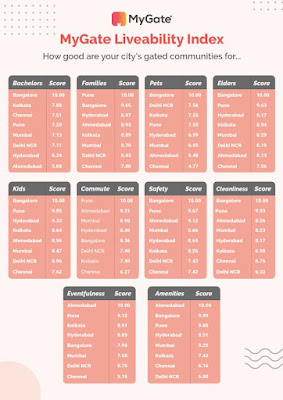
India’s Silicon Valley, Bengaluru, has added another feather to its illustrious cap, emerging as the city with the best gated community living experience, as per MyGate’s Liveability Index for H2 2021. Out of the 10 parameters on which residents can rate their societies, Bengaluru has emerged the topper in six of them, with Ahmedabad leading in two and Mumbai and Pune ahead of the pack in one each.

The MyGate Liveability Index is based on inputs from residents of the 25,000 gated communities that use the app. The index is based on resident ratings of the society in which they reside across 10 parameters: bachelor friendliness, community safety, family friendliness, ease of commute, pet friendliness, cleanliness, kid friendliness, quality of amenities, eventfulness within the society and elder friendliness. The cities of Ahmedabad, Bengaluru, Chennai, Delhi-NCR, Hyderabad, Kolkata, Mumbai and Pune are part of the index.

According to the index, Bengaluru’s residents find their gated communities safer and cleaner while even being friendlier toward bachelors, pets, children and the elderly, relative to other cities. The city received the top score of 10 on all these parameters. Particularly on Bachelor Friendliness and Pet Friendliness, it had no close competition, with Kolkata (7.88 [relative to Bengaluru]) and Delhi-NCR (7.56) coming in second place. Ahmedabad was voted least accommodating of bachelors with a score of 5.08 and Chennai was least accommodating of pets with a score of 4.77.

While Pune finished at the top in just two categories (Family Friendliness and Ease of Commute), it placed in the top three on eight out of 10 parameters. Ahmedabad topped in two categories (Quality of Amenities and Eventfulness).

Elaborating on the findings of the Index, Abhishek Kumar, COO & Co-founder, MyGate, says, “Residents of gated communities are looking for a better lifestyle for the entire family, not mere accommodation. It is interesting to see how gated communities in different cities are delivering on this expectation and where residents perceive room for improvement. We hope these insights provide administrators with direction to improve gated community living.”

About MyGate

Founded in 2016, MyGate is the largest community app in the country, simplifying urban living of over 3.5 million homes in 25,000+ housing societies. It was ranked #4 on YourStory’s list of India’s Most Disruptive Start-ups in December 2019 and one of India’s coolest start-ups by Business Today in 2019. MyGate was founded by Vijay Arisetty, an ex- IAF pilot (Shaurya Chakra awardee), Abhishek K, former VP at Goldman Sachs, and Shreyans Daga, former project head at Oracle and Digit.

SIRO Becomes The First CRO In India To Introduce A Hybrid Working Model


* #Siroflexiwork, backed by robust monitoring mechanisms, will help employees achieve a better work-life balance.

SIRO Clinpharm, an end-to-end drug development solutions provider to the global healthcare industry, has announced the introduction of a Flexiwork policy for its employees, which would enable them to work within a hybrid environment and enjoy a healthier work-life balance.

SIRO made the decision to implement a hybrid working policy to create a thought-leader model of flexible working, which allows employees to work from their agreed-upon base location, with robust monitoring mechanisms, and a mandate to attend certain days in the office each month to facilitate team meetings and inter-departmental coordination.   

Karan Daftary, Director of SIRO Clinpharm, commenting on the move said, “Rather than being reactive to the situation created by the pandemic, the team at SIRO looked at where they envisioned the organization to be positioned in the next 3-5 years. Hybrid working is here to stay and given the young leadership and quick decision-making abilities, we decided to completely switch to the new model of working overnight while ensuring a framework is in place,”

Currently, the company has launched a three-month pilot to test the implementation of the policy which will then be improved and extended based on the feedback and observation from employees and senior stakeholders. The decision to introduce the policy was taken after an internal survey by SIRO, in which its employees expressed satisfaction with the work-life balance provided by the new hybrid model. The survey also showed that majority of the employees preferred a flexible work policy which allows them to work from their base location, while visiting office few times in a month.

After a thorough analysis and discussion, a minimum four days of attendance a month for each employee has been mandated. In addition, team meetings and review meetings will be conducted regularly to ensure the connect is maintained between departments and deliverables are met.

As a measure to ensure discipline and a strong framework, the organization created a web-based calendar system which enables vertical business leads or managers, to plan meetings at the start of the month in the ‘SIRO monthly calendar’ and circulate it to all team members to prepare them for the days they are expected in the office. Each meeting is clearly defined with purpose and objectives and can be customized monthly based on business needs and requirements. . A provision for need based meetings and reviews have been made a part of the Flexiwork policy.

In addition to the monthly calendar, the company will also maintain a strong mechanism to ensure productivity in the flexible work model by mandating filling of weekly timesheets, regular catch-up meetings and frequent performance reviews.

The company firmly believes that this hybrid model would provide a great balance between ensuring work-life balance of current employees as well as a comforting environment for new employees to join.

About SIRO

SIRO Clinpharm is a global healthcare company that provides end-to-end drug development services. SIRO Clinpharm has a 20-year track record of working with the world's leading biopharmaceutical and medical device businesses. Oncology, diabetes, cardiology, infectious disorders, and the respiratory system are among the many therapeutic areas in which they have worked. Depending on the demands of our clients, we offer adaptable business models across service verticals. The Healthcare and Fitness Leadership Awards 2016, organised by CMO Asia and Stars of the Industry Group, named it the 'Best Clinical Research Company' of the year. SIRO has also won Frost & Sullivan's 'Indian Clinical Research Organization of the Year' award two times (2020 and 2022).

Information Technology Key Q3 Trends: Revenue Growth Momentum Strong; Supply-Side Challenges Persist


* Revenue growth momentum was strong in a seasonally soft quarter, driven by a broad-based secular demand environment. We believe that robust broad-based demand and a healthy deal intake/pipeline provide good near-term revenue visibility.

* Tier-1 companies' margins were flat to lower sequentially and lower on a YoY basis due to supply-side challenges. Barring PSYS, Tier-II IT Services companies reported expansion in their EBITM sequentially amid tight labor markets.

*  Tier-II companies outperformed Tier-I peers in sequential revenue growth and margin. Margin expansion was aided by revenue growth-led operating leverage, offshore shift, and productivity improvement, which offset cost inflation due to tight labor markets.

* We roll forward our target prices to Mar'24 and raise CoE assumptions, considering an uptick in interest rates. We upgrade WPRO to BUY. Our pecking order is INFO, WPRO, TECHM, HCLT and TCS among Tier-1 names, and PSYS, MPHL, ROUTE, BSOFT, ECLX and FSOL in mid-caps.

Total Pageviews